The Most Requested Feature Is Finally Here: Audit Trails
The Most Requested Feature Is Finally Here: Audit Trails
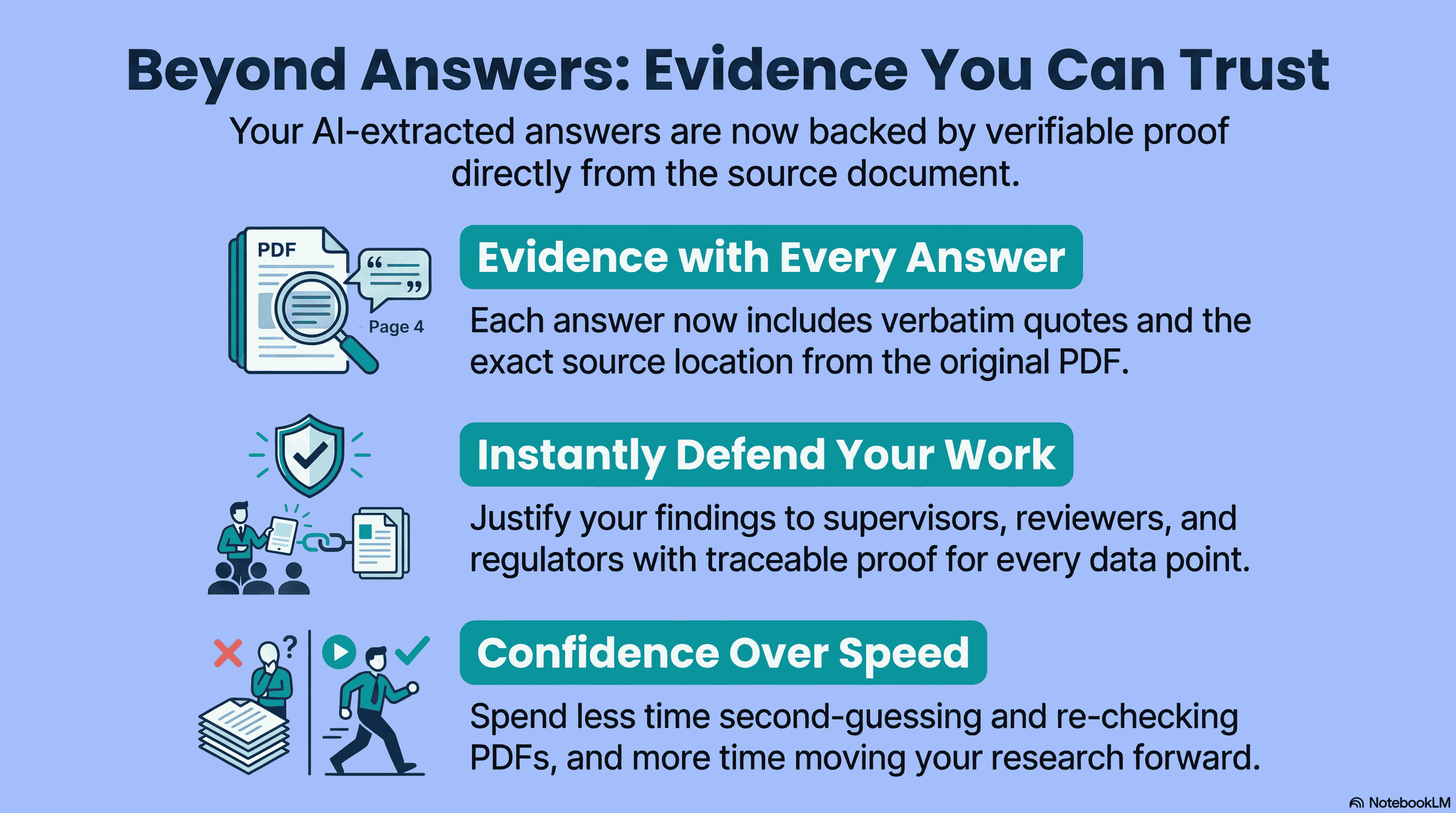
TL;DR: The new Audit Trail feature was the most requested update and it’s finally here. Every extracted answer is now backed by verbatim quotes from the source PDF, with clear pointers to where that information came from. This means more trust, better traceability, and far less second-guessing. You still get clear, concise answers but now you can see the evidence behind them, defend your decisions, and move forward with confidence."
There’s one piece of feedback I’ve heard more than any other since launching the Evidence Table Builder.
Not requests for speed. Not requests for more automation.
It was this:
“I love the answers… but where did they come from?”
And honestly? That’s a completely fair question.
For the past few months, I’ve been quietly working on the most requested feature in the platform: full audit trails for every extracted answer. It’s now live, and it fundamentally changes how you can trust, review, and defend your outputs.
This post explains why audit trails matter, what’s changed, and what this unlocks for your work, without getting lost in technical detail.
The Problem: Answers Without Evidence Aren’t Enough
If you’re newer to evidence tables or want to see how this fits into the wider workflow, these guides are a good place to start:
- What is an Evidence Table?
- Getting Started with Evidence Tables
- Quick Start Guide: Evidence Table Builder
- How Best to Use EvidenceTableBuilder for Systematic Literature Reviews
- Best Practices for Data Extraction in Systematic Reviews
Until now, the system did what many AI tools do well: it gave you clear, concise answers to your questions, extracted from research paper PDFs.
That’s useful. But for serious research work, it’s not sufficient.
If you’re working on a systematic review, HTA, CER, or any evidence-based report, you eventually hit the same wall:
- You need to check the answer
- You need to justify the answer
- You need to show reviewers where it came from
An answer on its own doesn’t do that.
Without traceability, you’re left double-checking PDFs manually, re-reading sections you thought you were done with, or worse, hesitating to trust the output at all.
That friction is exactly what this feature is designed to remove.
What an Audit Trail Actually Means
An audit trail is simple in concept:
Every answer now comes with its evidence attached tab in the excel output.
Not a summary. Not an interpretation. The exact words from the paper, copied verbatim, with a clear indication of where they came from.
That means:
- You can see why an answer was given
- You can jump straight to the relevant section in the PDF
- You can assess the strength of the evidence yourself
Instead of asking “Do I trust this?”, you can ask the much better question:
“Is this evidence strong enough for my purpose?”
That’s a subtle shift, but it’s an important one.
In traditional workflows, this kind of documentation is manual and time-consuming, even though it’s long been recommended in guidance such as the Cochrane Handbook for systematic reviews.
Why This Was So Heavily Requested
After speaking to researchers, PhD students, consultants, and industry teams, a pattern kept repeating.
People weren’t worried about the AI being wrong. They were worried about being unable to defend the result later.
Especially when:
- A supervisor asks, “Where does this come from?”
- A reviewer challenges a data point
- A regulator wants traceability
- You return to a project months later and can’t remember why a decision was made
Audit trails turn the output into something you can stand behind, not just something you can copy-paste.
What’s Changed in Practice
From a user perspective, the experience stays simple.
You still ask questions. You still get clear answers.
But now, behind every answer, you’ll also see:
- One or two verbatim quotes from the paper
- A clear indication of where those quotes appear (section, table, page, etc.)
- A confidence signal that reflects how clear or ambiguous the source was
If something genuinely isn’t reported in the paper, that’s made explicit too. No guessing. No filler. No false confidence.
And importantly: this extra transparency doesn’t slow your workflow down or clutter your results.
Why Audit Trails Matter for Quality Review Tools
This feature wasn’t built for demos. It was built for real research conditions.
Audit trails are there for moments when:
- You’re challenged on a data point
- You need to extract the same data twice, months apart
- You’re collaborating with others and need shared clarity
- You’re working under regulatory or publication standards
Transparency and traceability aren’t just “nice to have” features, they’re core principles reflected in reporting standards like the PRISMA 2020 guidelines for systematic reviews.
In other words, when the work actually matters.
Annotation AI vs Audit Trails: What’s Better for Defensibility?
Annotation AI can help you highlight, label, and summarise parts of a paper faster.
But in systematic reviews, HTA, and HEOR workflows, an audit trail is usually more defensible because it connects each extracted value to:
- verbatim supporting text, and
- a clear source location you can check later (and show to someone else).
In practice, the best workflow is often both:
- use annotation to speed up reading and discussion,
- use audit trails to make your evidence table checkable and audit-ready.
If you’re building evidence tables under scrutiny, this pairs well with: Best Practices for Data Extraction in Systematic Reviews and How to Choose the Right Quality Assessment Tool.
A Personal Note
This feature took time to get right, and that was intentional.
I didn’t want to bolt on “evidence” as an afterthought. I wanted something that genuinely supports trust, traceability, and human judgement, without turning the tool into a complicated mess.
So if you’ve been asking for audit trails, thank you for your patience. And if you’ve ever felt that quiet hesitation before trusting an AI-generated answer, this update is for you.
Clear answers are useful. Defensible answers change how you work.
More improvements are coming, but this one felt important enough to pause and talk about properly.
Because research deserves tools that don’t just save time, but protect confidence.
Related reading
- How Best to Use EvidenceTableBuilder for Systematic Literature Reviews
- Best Practices for Data Extraction in Systematic Reviews
- Automated Data Extraction for Systematic Reviews (HEOR & Market Access)
- What Columns Should an Evidence Table for a Systematic Review Include?
- How to Choose the Right Quality Assessment Tool
Tags:

About the Author
Connect on LinkedInGeorge Burchell
George Burchell is a specialist in systematic literature reviews and scientific evidence synthesis with significant expertise in integrating advanced AI technologies and automation tools into the research process. With over four years of consulting and practical experience, he has developed and led multiple projects focused on accelerating and refining the workflow for systematic reviews within medical and scientific research.